
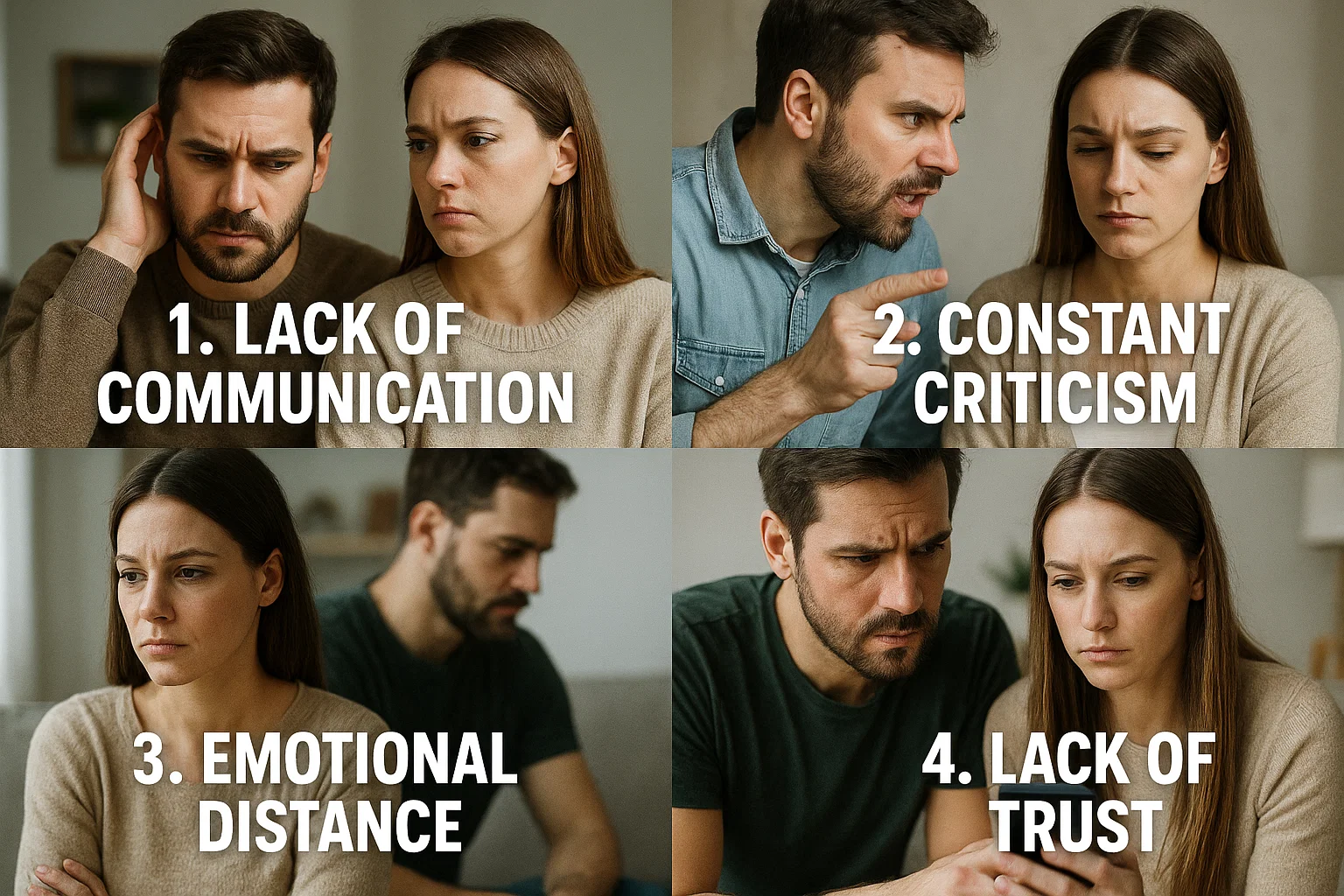
It’s 3:14 AM. The blue light from your phone is the only thing illuminating the bedroom. Beside you, your partner is asleep, breathing deeply, oblivious to the fact that you are staring at the ceiling with a knot of anxiety in your chest so tight it hurts to breathe. You type the words into the search bar, trembling a little: What are the four signs a relationship is failing?
I’ve been the woman in that bed.
I remember the specific texture of the sheets. I remember the sound of the fan. I remember looking at the man sleeping next to me—a man I had promised to spend my life with—and feeling absolutely nothing. No hate. No anger. Just a terrifying, empty numbness.
We weren’t throwing plates. We weren’t screaming. To our friends, we were the “solid” couple. But inside the walls of our apartment, we were slowly suffocating.
If you are reading this, you aren’t looking for textbook definitions. You don’t want clinical jargon. You want to know if the gut feeling you’ve been ignoring is actually a siren. You want someone to look you in the eye and tell you if you’re crazy or if you’re seeing the end.
You aren’t crazy.
While every relationship crashes in its own unique way, the wreckage usually looks the same. There are patterns. Distinct, undeniable shifts in energy that signal the bond is broken.
More in Category
How soon is too soon to be exclusive
Key Takeaways
- The Eye-Roll is Lethal: When you stop respecting them, you start treating them with contempt. That’s the beginning of the end.
- Silence is Louder than Yelling: Apathy kills love faster than anger ever could.
- The Body Knows First: If you physically recoil when they touch you, your body has already broken up with them.
- The Future Shrinks: You stop saying “We” and start planning for “I.”
Why Does It Feel Like You’re Enemies Instead of Teammates?
Let’s be real about fighting. My parents have been married since the 70s. They bicker. They argue about who left the garage door open. That isn’t dysfunction; that’s cohabitation.
But there is a shift that happens when a relationship is rotting from the inside out. You stop fighting the problem and start fighting the person.
In the last year of my relationship, I didn’t just get annoyed that he left his dishes in the sink. I saw the dishes as a personal attack. I told myself, “He does this because he doesn’t respect my time. He’s selfish.”
See the difference?
Are you attacking who they are, not just what they did?
This is what Dr. John Gottman calls “Criticism,” but let’s call it what it is: character assassination.
You stop saying, “Hey, it frustrates me when we run late.” You start saying, “You are always late because you only care about yourself.”
When you use absolute words like “always” and “never,” you aren’t asking for change. You’re handing down a verdict. You’re telling them they are flawed at their core. And what do people do when they are attacked? They defend themselves. They put up walls. Suddenly, you aren’t two people trying to make dinner; you’re two lawyers arguing a case you both intend to win.
Has a nasty sarcasm crept into your daily talk?
This is the ugly cousin of criticism. It’s the snide comment. The mocking tone. The eye-roll that says, “I am so much better than you.”
I remember a moment that makes me cringe to this day. My ex was talking about a book idea he had. Instead of listening, I let out a short, sharp laugh. “You? Writing a book? You haven’t even finished reading one this year.”
It was cruel. It was unnecessary. And it was the moment I should have known we were done.
That venom is called Contempt. It is the single biggest predictor of divorce. It acts like sulfuric acid on love. You cannot love someone you look down on. You cannot build a life with someone you mock. If you find yourself making jokes at their expense in front of friends just to get a laugh, check yourself. That isn’t humor. It’s hostility masked as a punchline.
When Did You Stop Telling Them the Little Things?
Silence is tricky. We mistake it for peace. We think, “Oh good, we didn’t fight today.” But sometimes, the lack of conflict just means you’ve stopped caring enough to engage.
Psychologists refer to this as “Stonewalling” or emotional withdrawal. I call it “The Roommate Phase.”
Who is the first person you text when something good happens?
Test yourself right now.
Let’s say you find twenty dollars on the street. Or you see a hilarious vanity license plate. Or your boss gives you a compliment.
Who do you want to tell?
In a healthy love, your partner is your witness. They are the person who catalogs the tiny, boring details of your existence.
Toward the end, I stopped telling him things. I got a promotion at work—a huge deal for me—and I texted my sister. I called my mom. I told the guy making my latte. I didn’t tell my partner until six hours later, and even then, I casually mentioned it while brushing my teeth.
Why? Because I didn’t want to deal with his reaction. I told myself I was “protecting” my joy, but really, I was hoarding it. I was already living a separate life; I just hadn’t moved my boxes out yet.
Are you lonely even when you’re sitting on the same couch?
This is the loneliest feeling in the world. You are physically together—maybe watching Netflix, maybe eating takeout—but emotionally, you are miles apart.
You scroll on your phone. They scroll on theirs. You live in parallel lines that never intersect.
I convinced myself this was just “independence.” I thought we were being modern and cool by having our own lives. But looking back, I see it for what it was: indifference. The opposite of love isn’t hate; it’s not caring. It’s looking at them and feeling… neutral.
If you haven’t asked them a question deeper than “what’s for dinner?” in a month, you are walking on a crumbling bridge.
Why Does Your Skin Crawl When They Touch You?
We have to talk about the body.
Your brain is a master manipulator. It can rationalize anything. It can tell you, “He’s a good father,” or “She makes decent money,” or “We’ve been together ten years, you can’t just throw that away.”
But your body? Your body is terrible at lying.
Do you flinch when they reach for you?
There is a phenomenon I call “The Recoil.”
It started subtly for me. He would come up behind me to hug me while I was doing dishes, and my shoulders would tense up. I would lean away, just an inch. I felt crowded. I felt suffocated.
I made excuses. “I’m just touched out,” I’d say. “I’m stressed.”
But the truth was darker. My body was rejecting him before my mind was ready to admit it was over. Unresolved resentment kills physical intimacy. It’s hard to be vulnerable and naked with someone when you feel misunderstood or disrespected.
Have you stopped the casual, accidental touching?
Think about the early days. You couldn’t sit next to each other without your knees touching. You held hands in the car. You brushed hair out of their eyes.
These are “micro-touches.” They are the glue of intimacy.
When a relationship is failing, you become hyper-aware of your personal space. You sleep on the absolute edge of the mattress to ensure no skin touches skin. You pull your hand away quickly. You stop greeting them with a kiss.
Once the physical connection is severed, you are just two people sharing rent. And Gottman’s research backs this up—without positive affection to balance out the stress, the relationship starves.
When Did You Start Planning a Future for One?
Relationships are, at their core, a shared hallucination of the future. You agree to walk toward the same horizon.
When the end is near, that horizon splits in two.
Is their face blurry in your mental picture of next year?
Close your eyes. Seriously, do it.
Imagine your life two years from today. Where are you living? What does the Sunday morning coffee smell like? Who is sitting across from you?
If you struggle to see their face, or if the idea of them being there makes you feel tired and heavy, pay attention.
I caught myself doing this while browsing Zillow. I told myself I was just looking at “dream homes.” But I noticed I was only looking at small, city apartments. Places perfect for one person. Places that had no room for his drum kit.
Subconsciously, I was already nesting for a single life.
Have you stopped using the word “We”?
Language is a tell. Listen to how you talk to your friends.
- “I’m thinking of taking a trip.”
- “I need to save more money.”
- “I want to get a dog.”
When the “We” dissolves into “I,” the partnership is fractured. You are no longer operating as a unit. You are prioritizing your own survival.
You might start hiding money. You might apply for jobs in other cities without talking to them first. You keep secrets not because you are malicious, but because you no longer feel like you owe them your full truth. You are packing your emotional bags long before you pack the physical ones.
Is It Time to Let Go?
Reading this is hard. I know it is. If you saw yourself in these words, you probably feel a heavy rock settling in your stomach.
But here is the thing: Knowing is better than wondering.
Living in the limbo of a failing relationship is torture. It drains your energy, your confidence, and your joy. You deserve more than a “maybe.” You deserve more than a roommate you resent.
Acknowledging these signs doesn’t mean you have to break up today. It means you have to stop lying to yourself.
Maybe you can fix it. Maybe you can take this list to a therapist and say, “We are drowning, help us.”
Or maybe, you realize that the kindest thing you can do for both of you is to let go.
I stayed two years too long because I was terrified of the silence. I was scared of being alone. But when I finally left, I didn’t feel sad. I felt like I could finally take a full breath for the first time in forever.
Trust your gut. It’s been screaming at you for a reason. Listen to it.
FAQ – What are the four signs a relationship is failing
How does loss of respect manifest in a failing relationship?
Loss of respect often appears as contempt, characterized by behaviors like eye-rolling and sarcasm, which can escalate to character assassination and contempt, acting as significant predictors of relationship breakdown.
What does emotional withdrawal or stonewalling look like in a relationship?
Emotionally withdrawing or stonewalling involves a lack of engagement, silence, and distance, which signals that the emotional connection has weakened or broken down.
Why is physical discomfort or recoil when touched an important sign?
Physical recoil, like flinching or pulling away when touched, indicates unresolved resentment and emotional disconnection, often reflecting internal rejection of the partner.
What does it mean when you stop planning a future together and start envisioning a life alone?
It signifies a deep emotional separation where the shared vision of the future dissolves, often accompanied by difficulty in recalling their face in your mental picture and using ‘I’ instead of ‘we’ in your language, indicating the relationship is nearing its end.