
I remember sitting across from my best friend, Sarah, at a cramped, overly air-conditioned coffee shop in downtown Chicago. It was one of those places where the espresso machine screams every thirty seconds, drowning out half the conversation. But I didn’t need to hear her clearly to know she was falling apart. I watched her tear a flimsy paper napkin into tiny, snowy shreds, piling them up like a miniature mountain of anxiety on the sticky table.
She looked up at me, eyes red-rimmed and devoid of makeup, and asked the question that haunts almost every woman I know at some point in her life: “Is this normal?”
She was talking about her partner’s jealousy—he’d thrown a fit because she smiled at a waiter—but she could have been talking about anything. The silence at dinner. The bickering over whose turn it is to do the dishes that somehow turns into a character assassination. The loneliness that creeps in even when you’re sitting on the same beige sofa, watching the same Netflix show.
We live in a world that romanticizes the “chase.”
We grew up on movies where the guy stands outside the window with a boombox, or they scream in the rain and then kiss. We’ve normalized toxicity and labeled it “passion.” It gets confusing. I’ve been there. I spent my twenties thinking that if we weren’t fighting and making up, we weren’t really in love. I thought stability meant boredom. I thought peace meant we had run out of things to say.
It took a lot of heartbreak, a few disastrous breakups that left me eating cereal on the floor, and a lot of therapy to realize that peace is actually the goal.
If you are currently staring at your ceiling at 2 A.M., listening to the rhythm of your partner’s breathing and wondering if this partnership is built to go the distance, you aren’t alone. We need to strip away the Hollywood fluff. We need to stop looking at Instagram couples who curate their lives to look perfect. We need to look at the brass tacks of day-to-day survival with another human being.
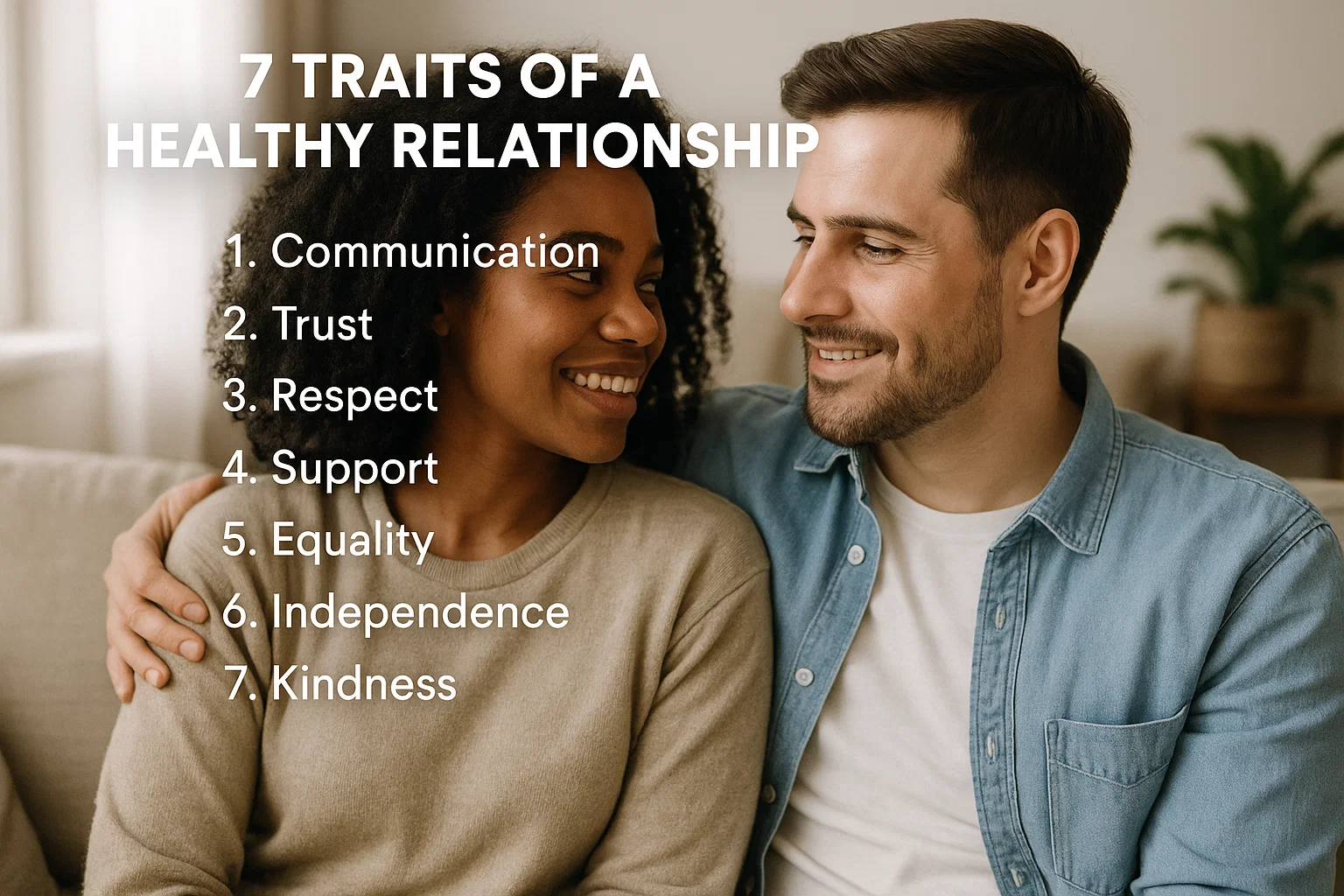
You want to know, practically and realistically: What are the 7 traits of a healthy relationship?
Here is what I’ve learned, not just from textbooks or psychology articles, but from the messy, beautiful trenches of real life.
More in Category
How long do you date before becoming a boyfriend/girlfriend
Key Takeaways
- Trust is a verb, not a noun: It’s built through a million boring, consistent actions, not just grand promises.
- Conflict is inevitable: The goal isn’t to avoid fighting; it’s to fight without destroying the other person’s dignity.
- Independence matters: You must remain a whole, separate person outside of the relationship, or the relationship will collapse under the weight.
- Communication is about comprehension: Talking is useless if you aren’t actually understanding the message behind the words.
- Playfulness protects: Laughter acts as a buffer against life’s inevitable stress; if you can’t laugh, you won’t last.
- Growth is optional but necessary: You will change. The secret is changing in the same direction, or at least parallel to each other.
- Mutual Respect is the baseline: Without it, affection is just a performance.
1. Can You Leave Your Phone Unlocked Without Panicking? (Trust)
We have to start here. If we don’t have trust, we don’t have anything. We just have two people engaging in surveillance. But I’m not talking about the blind faith that he won’t cheat on you with his secretary. That’s the baseline. I’m talking about a deeper, quieter kind of safety.
I dated a guy years ago—let’s call him Mark. Mark was charming, funny, and absolutely exhausting. If Mark didn’t text me back within twenty minutes, my stomach would physically knot up. I’d be at work, staring at a spreadsheet, but my brain was spinning wild stories. Was he mad? Was he with someone else? Did I say something stupid at breakfast? Is he realizing I’m not the one?
That anxiety wasn’t just about him. It was about the fragility of our bond. It felt like holding a Ming vase on a rollercoaster.
Contrast that with my husband now. He went on a bachelor trip to Vegas last year with his old college buddies. He forgot his charger. He didn’t call me for 24 hours. Not a text. Not a meme. Nothing.
Did I love that? No. It was annoying. Did I think he was running off with a showgirl? Not for a second.
I just assumed he was being an idiot with his battery life and probably losing money at a blackjack table. I went to sleep, I woke up, and I didn’t check his location once.
Why safety feels boring at first
Real trust feels like calm water. It lacks the adrenaline spike of insecurity. It’s not “exciting” in the way a rollercoaster is. It’s steady. It means you believe they have your best interests at heart, even when you aren’t in the room to supervise them.
You know you have this trait when you don’t feel the need to audit their life. You don’t check their DMs. You don’t demand to see who they are snapchatting. You assume good intent. If they say they are tired, you believe they are tired, not avoiding you. You stop reading between the lines because there is nothing hidden there.
2. Are We Actually Listening, or Just Waiting to Talk? (Communication)
“You never listen to me!”
It’s the cliché scream in every movie argument. It’s the line that precedes a door slam. But communication isn’t just about vocalizing your needs; it’s about the reception of those needs. It’s about the ball being caught, not just thrown.
I used to be a terrible listener. Truly awful. I was a “fixer.” My partner would come home, toss his keys on the counter, and start venting about his boss, Dave. Before he could even finish describing the meeting, I was jumping in.
“Well, did you tell HR? You should update your LinkedIn. Maybe you should just refuse to do that project.”
I thought I was being helpful. I thought I was being a power-couple partner. I wasn’t. I was invalidating his feelings because I was uncomfortable with his stress. I wanted to fix it so I didn’t have to feel his bad mood anymore.
The difference between venting and solving
Healthy communication requires decoding what the other person actually needs in that moment. We instituted a rule in our house that changed everything. It felt awkward at first, but now it’s automatic. When one of us starts venting, the other asks:
“Do you want comfort or solutions?”
Nine times out of ten? We just want comfort. We just want to be heard. We want someone to say, “Wow, Dave sounds like a nightmare. I’m sorry today sucked.”
And then there’s the hard stuff. We also need to talk about the things that make our palms sweat. Money. Sex. In-laws. The weird way he chews. If you are walking on eggshells to avoid a specific topic because you’re afraid it will trigger a meltdown, that is a crack in the foundation.
A healthy relationship provides a platform where you can say, “Hey, what you did yesterday hurt my feelings,” without fearing that the relationship will end because of it. You don’t have to curate your words perfectly. You can be messy, as long as you are honest.
3. Do You Still Remember Who You Were Before “Us”? (Independence)
This one is tricky for women. We are socialized, from the time we are given baby dolls, to be caretakers. We merge. We blend. We become “we.”
I lost myself entirely in a relationship in my late twenties. I stopped running (which I loved and kept me sane). I stopped seeing my friends on Friday nights because that was “our” time. I started listening to his heavy metal music and forgot I actually preferred indie folk. I ate what he wanted to eat. I watched what he wanted to watch.
When that relationship ended—inevitably—I didn’t just lose a boyfriend. I faced a terrifying void where my personality used to be. I sat on my bed and realized I didn’t even know what kind of pizza I liked anymore because we always ordered pepperoni.
The Venn Diagram Theory
Think of two circles. In a codependent relationship, those circles overlap completely until they are one circle. That feels like romance, but it’s actually suffocation. In a healthy relationship, the circles overlap in the middle, but there are distinct crescent moons on either side.
You need your own hobbies. You need your own friends who knew you before him. You need your own inner world that he cannot access.
- Green Flag: Your partner encourages you to go on that girls’ trip or take that pottery class on Tuesday nights. He pushes you out the door because he knows it makes you happy.
- Red Flag: They guilt-trip you for spending time away from them. They text you incessantly when you are out. They make you feel like your independence is a betrayal of the relationship.
Maintaining your individuality makes you a more interesting partner. You have new stories to tell at dinner. You have energy that comes from a source other than your spouse. You aren’t looking to them to be your entire universe; you’re just looking for them to be a planet in your solar system. A favorite planet, sure, but not the sun.
4. Is “No” a Complete Sentence in Your House? (Respect)
Respect is often confused with politeness. You can be polite to a stranger at the DMV. Respecting a partner is deeper. It’s about honoring their boundaries, their autonomy, and their humanity, even when it’s inconvenient for you. Especially when it’s inconvenient for you.
Let’s get specific. Respect means you don’t roll your eyes when they talk about something they are passionate about, even if you find it boring as hell. It means you don’t make jokes at their expense in front of friends to get a cheap laugh. It means you don’t interrupt them constantly.
The Boundary Test
I have a hard boundary about my morning coffee. I am not a nice person before caffeine. I need fifteen minutes of silence before I can human. My husband? He is a morning person. He wakes up with the energy of a Golden Retriever who just saw a squirrel.
Early on in our marriage, he’d try to chat about schedules, dinner plans, and the news while I was still staring blankly at the kettle, waiting for the water to boil. I snapped at him once. “I can’t do this right now. Please stop.”
Disrespect would be him saying, “You’re being dramatic,” or continuing to talk because he wanted to talk and his desire mattered more than my boundary. Respect is what he actually did: he backed off. He didn’t pout. He didn’t get passive-aggressive. Now, he brings me a cup and walks away until I emerge from the bedroom, human again.
5. Do You Fight to Win, or Do You Fight to Solve? (Conflict Resolution)
If anyone tells you they “never fight,” run away. Seriously. They are either lying to your face, or one person has completely given up and is silently suffering to keep the peace.
Conflict is healthy. It’s inevitable. It proves you are two different people with different perspectives and different histories. The trait to look for isn’t the absence of fighting; it’s the style of fighting.
My parents fought like cats and dogs. Screaming matches that shook the walls. Door slamming. The silent treatment that lasted for days, turning the house into a mausoleum. I grew up thinking that conflict was war. You had to win. You had to hurt the other person so they understood how much you hurt. You had to score points.
The “Us Against the Problem” Mentality
It took me years to unlearn that toxicity. In a healthy dynamic, you shift the geometry of the argument. It’s not You vs. Me. It’s Us vs. The Issue.
John Gottman, a relationship researcher who has watched thousands of couples argue, talks about the “Four Horsemen” that predict divorce: criticism, contempt, defensiveness, and stonewalling. Of these, contempt is the deadliest. Contempt is rolling your eyes. It’s sneering. It’s acting like you are better than your partner. Research from the University of California, Berkeley supports the idea that how we navigate negative emotion determines relationship longevity.
Healthy couples fight fair.
- They don’t name-call. Once you call someone an idiot, the argument is over; you’ve just moved into abuse.
- They don’t bring up mistakes from 2015 to win an argument in 2024. Stick to the current issue.
- They know how to repair.
Repair attempts are crucial. It’s that moment in the middle of a heated argument where someone cracks a small joke, or touches the other person’s arm, or says, “I’m sorry, I’m yelling because I’m stressed, let me start over.” If you can accept a repair attempt, you’re going to be okay. If you smack the hand away, you’re in trouble.
6. When Was the Last Time You Laughed Until It Hurt? (Intimacy and Play)
Intimacy is often shorthand for sex, and yes, physical connection is vital. We can’t ignore that. But intimacy is also the inside jokes. It’s the secret language you develop that nobody else understands. It’s the ability to be absolutely silly without fear of judgment.
Life is hard. It just is. Parents get sick and die. Bills pile up. Roofs leak. Jobs get lost. If you cannot laugh with your partner, the weight of the world will eventually crush the relationship. You need a release valve.
I remember the day we moved into our first house. It was a disaster. The moving truck broke down on the highway. It was pouring rain. We got the keys, walked in, and discovered a massive spider infestation in the basement. I’m talking hundreds of them. I sat on a wet cardboard box and started crying. It was just too much.
My husband looked at me, picked up a broom, held it like a microphone, and started conducting a mock interview with one of the spiders on the wall. He gave the spider a ridiculous French accent.
It was stupid. It was childish. But I started laughing through the snotty tears. And suddenly, the problem wasn’t us against the world; it was us laughing at the absurdity of it all.
The Physical Connection
And regarding the physical side: It changes. The desire you feel in month three is different from the desire in year ten. A healthy relationship acknowledges this flux. It’s not about having swinging-from-the-chandeliers sex every single night. Who has the energy for that?
It’s about maintaining a thread of connection. Holding hands while driving. Hugging for longer than three seconds when you get home. Touching their back when you walk past in the kitchen. Making sure the other person feels desired and seen, not just as a roommate who helps pay the mortgage, but as a lover.
7. Are We Growing Together or Just Growing Older? (Adaptability)
Here is the scary truth that nobody tells you at the wedding: The person you marry (or commit to) will not be the same person in five years. You won’t be either.
I am not the woman I was at 25. At 25, I wanted to travel the world and live out of a backpack. At 35, I want a garden and a 401k. I have different career goals, different anxieties, and a softer body. If my husband insisted on me staying exactly the same girl he met at that bar, we would have divorced years ago.
Adaptability is the secret sauce. It is the willingness to let your partner evolve. It’s the grace to let them change their mind.
Embracing the Seasons
Maybe one of you wants to go back to school at 40. Maybe one of you struggles with depression for a season and can’t carry the load. Maybe you decide to move across the country on a whim.
In unhealthy relationships, change is seen as a threat. “You’ve changed” is thrown around as an insult. In healthy relationships, change is expected. You re-commit to each other through the different versions of yourselves. You support their growth even when it’s inconvenient for you.
I recently decided to pivot my career, which meant a significant pay cut and more hours working on weekends while I built a portfolio. My husband didn’t complain about the inconvenience or the tighter budget. He didn’t make me feel guilty. He sat down with Excel and asked, “Okay, how can we adjust our spending to make this work for you?”
That is the essence of growth. It’s looking at your partner and saying, “I love who you are, and I’m excited to meet who you are going to become.”
The Reality Check: No Relationship scores 100%
Reading through this list, you might feel a pang of panic. I get it. Perfectionism is a beast. Maybe you score high on trust but your communication is a disaster. Maybe your conflict resolution consists of pouting for three days.
That’s okay. Breathe.
These 7 traits are not a checklist for perfection; they are a compass. No couple gets it right every single day. We all snap when we’re tired/hungry/stressed. We all have moments of irrational jealousy. We all check out and stare at our phones instead of listening.
The difference lies in the intention and the trajectory. Are you both trying? When you mess up, do you own it? Do you come back and say, “I was a jerk, I’m sorry”?
When I look back at that conversation in the coffee shop with Sarah, watching her shred that napkin, I realize now what I should have told her. I shouldn’t have just analyzed her boyfriend’s flaws or given her a magazine checklist.
I should have asked her how she felt when she was with him. Not how she felt about him—how she felt with him. Did she feel like the best version of herself? Or did she feel small, anxious, and managed?
So, take a deep breath. Look at your partner. If you have the trust, the respect, and the willingness to grow, you’ve got the foundation. The rest? It’s just work. And the best things in life always are.
FAQ – What are the 7 traits of a healthy relationship
Why is trust important in a relationship?
Trust is crucial because it creates a sense of safety and calmness, enabling partners to feel secure without constantly monitoring or doubting each other.
How can I improve communication with my partner?
Effective communication involves listening to understand, not just to respond, and clarifying whether your partner wants comfort or solutions during conversations.
What does independence look like in a healthy relationship?
Independence means maintaining your own hobbies, friendships, and inner world outside of the relationship, ensuring you remain a whole person.
How should partners handle conflicts healthily?
Healthy conflict resolution involves fighting fair, focusing on the issue rather than attacking each other, and making repair attempts to reconnect after disagreements.