
You know the feeling. The restaurant is dimly lit, the appetizers are overpriced, and you are sitting across from a woman who is smiling at you. But in your head, there is a chaotic monologue running on a loop: Is she actually having a good time? Does that glance mean she likes me, or is she looking for the waiter to bring the check?
It is exhausting.
As a woman, I’m going to let you in on a secret: we are often just as nervous as you are. But we are also conditioned by society to be polite, agreeable, and non-confrontational. This means our words (“Oh, I’m fine!”) often mask our true feelings. However, biology is harder to suppress. While I can force a smile, I can’t force my pupils to dilate. I can tell you I’m interested, but I can’t stop my feet from pointing toward the exit if I feel unsafe.
Decoding female body language isn’t about becoming a mind reader or a manipulation artist. It’s about empathy. It’s about quieting your own insecurity long enough to actually see the human being in front of you. When you stop guessing and start observing, the whole game changes. You stop performing and start connecting.
More in Category
Creating Sexual Tension and Oneitis Cure
Key Takeaways
- Look for Clusters, Not Solo Acts: One crossed arm means nothing; crossed arms plus looking away plus tapping a foot means everything.
- The “Vulnerable Neck” Rule: If she moves her hair to expose her neck, it is a primal, biological signal of comfort and submission to the interaction.
- The Table is Real Estate: Watch how she claims or yields space on the table; it reflects how much room she is making for you in her life.
- Feet Are Truth-Tellers: We are trained to control our faces, but we almost never think about our feet. Follow them to find her focus.
- Nervousness is a Good Sign: If she is clumsy, rambling, or fidgeting, she is likely intimidated by you—not bored.
Why does reading her signals feel like deciphering ancient code?
Here is the raw truth: it feels hard because there is so much interference. You are trying to pick up on subtle biological signals through a layer of makeup, high heels, social etiquette, and your own anxiety.
We are taught from the time we are toddlers to “be nice.” So, when I am on a date with a guy and I’m just not feeling it, I don’t usually say, “Hey, you’re great, but no.” That feels harsh. Instead, I nod. I laugh at jokes that aren’t funny. I ask polite questions about his job. To the untrained eye, I look engaged.
But if you knew what to look for, you’d see the cracks in the facade. You’d see that my torso is stiff. You’d notice my laugh stops abruptly rather than fading out. You’d see that I never actually lean in.
Understanding this “social mask” is step one. The mask is what handles the small talk. The real body language—the stuff that tells you if a second date is in the cards—comes from the limbic system. It is primal, reactive, and brutally honest.
What is the “Eyebrow Flash” and did you miss it?
Before you even sit down, there is a micro-signal that happens in a fraction of a second. It’s called the “eyebrow flash.”
When we see someone we know and like—or someone we find immediately attractive—our eyebrows shoot up and down rapidly. It lasts about one-fifth of a second. It is a universal human greeting signal that says, “I see you, and I am not a threat.”
If you walk up to greet her and her eyebrows stay flat and still, she might be feeling guarded or indifferent. But if those brows pop up for a split second along with a smile, you are starting on solid ground. It’s a tiny detail, but once you start noticing it, you will see it everywhere.
What are her eyes actually screaming at you?
Forget the cliché that “eyes are the window to the soul.” On a date, eyes are the primary indicator of attention and arousal. Decoding female body language starts here, but you have to go deeper than just eye contact.
The “Sticky Gaze” vs. The “Darting Scan”
When I am into a guy, my gaze becomes “sticky.” I don’t just look at him; I linger. When he finishes a sentence, I hold his eyes for a beat longer than is socially necessary. It feels intense because it is intense.
Watch for the triangle. If her eyes drop to your mouth and then snap back up to your eyes, her brain is subconsciously registering you as a potential mate. She is looking at your lips. Do the math.
On the flip side, watch out for the “scan.” If her eyes are constantly darting to the door, the bartender, or her phone screen, her brain is hunting for dopamine because you aren’t providing it. She isn’t just looking around; she is looking for an out.
The Pupil Check
This is the one signal I cannot fake, no matter how good of an actress I am. Oxytocin and dopamine cause pupil dilation.
If you are in a brightly lit coffee shop and her pupils look like giant black saucers while you’re talking about your passion for classic cars, take the win. She is physically absorbing you. Her autonomic nervous system is screaming, “I like what I see!”
According to research often cited by psychology hubs like The University of Texas Permian Basin, non-verbal cues can constitute a massive percentage of emotional communication. If her words say “cool” but her eyes are dead, believe the eyes.
Is she building a fortress or opening the drawbridge?
I want you to look at the table right now. Not at the food, but at the objects. The salt shaker, the menu, the wine glass, her purse.
These aren’t just random items; they are tools for territory and defense.
When I am uncomfortable or feeling pressured, I subconsciously build a wall. I’ll place my water glass directly between us. I’ll prop my menu up. I might even leave my purse on the table, creating a bulky physical barrier between my chest and yours. It’s a way to feel safe.
Now, watch what happens if the date goes well. I’ll move the candle to the side. I’ll put my purse on the floor. I will clear the visual line of sight between us. This is “unblocking.” It’s an invitation. It says, “I want nothing in the way of me getting to you.”
If she is clutching her wine glass with two hands in front of her chest, she is shielding her heart. If she leaves the glass on the table and talks with open palms, she is letting you in.
Why is the “Neck Expose” the ultimate biological surrender?
This is primal. In the animal kingdom, the neck is the most vulnerable part of the body. It houses the jugular vein and the carotid artery. A predator goes for the neck to kill.
Therefore, exposing the neck is the ultimate sign of trust.
If she tilts her head to the side while listening to you, exposing the side of her neck, she is subconsciously telling you, “I trust you not to hurt me.”
Even more potent is the hair adjustment. If she sweeps her hair to one side, clearing her shoulder and neck, it is a massive flirtatious signal. It releases pheromones (in theory) and draws your eye to that vulnerable, soft skin. If you see the neck expose, you are doing very, very well.
Why is the direction of her knees more honest than her words?
You are probably focusing on her face, which makes sense—that’s where the conversation is happening. But the face is the most trained liar on the body. We learn to fake smiles in kindergarten. We almost never learn to fake knee direction.
The feet and legs follow the “fight or flight” instinct. They point where the brain wants to go.
- The Exit Sign: If her torso is turned toward you but her feet are pointed toward the door, her brain is already in the Uber. She is ready to bolt.
- The Lock-In: If her toes are pointed directly at you, she is fully present.
- The Leg Cross: Watch the top leg. If she crosses her legs, does the top knee point towards you or away from you? If it points towards you, it acts as an anchor, keeping her in your space. If it points away, it creates a barrier, effectively blocking you out.
Is she grooming for you or soothing herself?
This is where guys get confused constantly. You see a girl playing with her hair or touching her face, and you think, “She’s flirting!”
Maybe. But she might also be stressing out. You need to distinguish between Preening and Pacifying.
Preening (She likes you):
- Smoothing out her skirt or dress.
- Checking her lipstick in the reflection of a spoon.
- Tucking hair behind her ear (especially if combined with eye contact).
- These gestures are about presentation. She wants to look good for you.
Pacifying (She is anxious or uncomfortable):
- Rubbing the back of her neck.
- Playing with a necklace nervously.
- Pulling at split ends.
- Scratching her arm.
- These are self-soothing behaviors. We do this to calm our nervous systems when we feel threatened or awkward.
If you ask a personal question and she immediately touches the hollow of her throat (the suprasternal notch), you’ve likely pushed too hard. Back off. Change the subject to something lighter.
How does the “Mirroring” effect actually work in the wild?
Mirroring is the gold standard of rapport. It’s what happens when two people are on the same wavelength.
When I am totally captivated by a man, I become a chameleon. If he leans forward, I lean forward. If he lowers his voice to a whisper, I match his volume. If he takes a sip of his drink, I suddenly realize I’m thirsty and grab mine.
I don’t plan this. It just happens. My mirror neurons are firing, trying to synchronize with his to create a bond.
The Test: You can actually test this. Shift your posture. Lean back in your chair and relax your shoulders. Wait about twenty or thirty seconds. Does she shift too? If she stays rigid and upright while you are relaxed, the connection hasn’t gelled yet. If she follows your lead, you are in sync.
Are those butterflies or red flags? (Nervousness vs. Rejection)
This is the tragedy of modern dating. I have friends who went on dates with great guys, but because they were so nervous, they acted stiff, cold, or weird. The guys assumed “not interested” and never called back.
You have to be able to tell the difference between “I’m bored” and “I’m terrified because I like you.”
Signs of Rejection/Boredom:
- Short, one-word answers.
- Pale complexion (blood leaves the face).
- Stillness. She conserves energy.
- Looking around the room.
Signs of Nervousness (High Attraction):
- The Blush: Redness in the cheeks or chest.
- The Fidget: Tapping fingers, playing with a napkin.
- Verbal Vomit: Rambling, talking too fast, or interrupting by accident because she’s afraid of silence.
- Giggling: Laughing at things that objectively aren’t funny.
If she is clumsy and spilling her water, she likes you. She’s intimidated. Take the lead. Be warm. Help her relax.
What does “The Lean” tell you about her boundaries?
Proximity is power. In a loud bar, you have an excuse to get close, but pay attention to the physics of the lean.
The Lean-In: If she leans her upper body across the table, she is entering your intimate zone. She is inviting you to smell her perfume. She wants to reduce the distance. This is an aggressive move in the best way possible.
The Lean-Back: If you lean in to emphasize a point and she instinctively rocks back in her chair to maintain the distance between you, you have breached the perimeter too early.
Respect the invisible bubble. If she pulls back, you pull back. Do not chase her into her chair. Give her space, and let her be the one to close the gap next time.
Can a subtle touch change the entire trajectory of the night?
Physical touch is the electric fence of dating. Crossing it is risky, but when the power is off, it opens the gate to romance.
Women use touch to test the waters. We rarely just grab a guy. We use “accidental” or socially plausible touches.
- A light brush of your forearm when you make a joke.
- “Comparing hand sizes” (the oldest trick in the book, but it works).
- Her knee bumping yours under the table—and staying there.
If she touches you, she has broken the barrier. It is a green light.
If you want to test the waters, start with a “safe zone” touch—like the elbow or the shoulder. Do not go for the thigh or the waist; that’s too intimate too fast. Touch her elbow lightly when you make a point. If she flinches or pulls away, stop. Message received. If she leans into it or smiles, you are good to go.
Is that smile real or is it just polite customer service?
We talked about eyes, but let’s talk about the smile specifically. There is a massive difference between a “Pan Am smile” (polite, fake) and a “Duchenne smile” (real joy).
A polite smile stops at the mouth. The lips curve up, but the rest of the face is frozen.
A real smile involves the orbicularis oculi muscles—the ones around the eyes. When I am genuinely laughing, my eyes crinkle. I get crow’s feet. My eyebrows lift. My whole face scrunches up.
If she is smiling with her mouth but her forehead is smooth and her eyes are wide and alert, she is “botox-smiling.” She is being polite. She is waiting for the story to end. Real joy is messy. Look for the scrunch.
What is her drink holding technique telling you?
This sounds wildly specific, but hear me out. The way she holds her drink can indicate her level of openness.
The Chest Guard: If she holds her drink up high, near her chin or chest, she is guarding herself. It’s another barrier. The Low Hold: If she holds the drink down on the table or rests it on her lap, leaving her chest and torso exposed, she is comfortable. The Caress: If she is stroking the stem of the wine glass or running her finger around the rim of the cup while looking at you, it is often a subconscious displacement of desire. She is thinking about touch.
How does her vocal pitch shift when attraction hits?
Decoding female body language isn’t just visual; it is auditory.
When a woman is attracted to a man, her voice often changes. It usually goes one of two ways:
- Higher and Softer: She unconsciously tries to sound more feminine and “small.” It’s a biological signal of submissiveness and receptivity.
- Lower and Huskier: This is the “bedroom voice.” It signals intimacy and trust.
The enemy here is Monotone. If she sounds flat, robotic, or like she’s reading a grocery list, she is bored. If her voice has dips, valleys, excitement, whispers, and range, she is emotionally invested in the conversation.
Are you catching the micro-expressions before they vanish?
Micro-expressions are involuntary facial expressions that occur within a fraction of a second. They expose a person’s true emotions before the “social mask” has time to slide into place.
You make a joke that’s a little edgy. Watch her face instantly.
- Does she flash a look of disgust (nose wrinkle) before she laughs? That disgust was real; the laugh was social.
- You mention your ex-girlfriend. Does her mouth tighten or her eyes narrow for 0.5 seconds? That’s jealousy. That’s good—it means she wants you for herself.
Catching these requires you to be fully present. You can’t be thinking about your next witty line. You have to be watching her face like it’s the only thing that matters in the room.
Why is her phone the third wheel you need to watch?
This seems obvious, but the nuance is key.
- Face Up on Table: You are competing for attention. She is keeping a line open to the outside world.
- In the Purse: You are the priority.
- The Bathroom Check: If she checks it when you go to the restroom, that’s normal. Everyone does that.
- The Mid-Conversation Check: If she lights up her screen while you are in the middle of a story, it is the kiss of death. It signals a complete lack of respect.
Exception: If she pulls out her phone to show you a photo of her dog or a meme related to what you are talking about, that is bridging. She is using the phone to bring you closer, not to push you away.
How do you synthesize all this without looking like a creep?
Here is the danger: you read this article, and suddenly you are staring at her kneecaps and analyzing her blink rate like a scientist. Don’t do that. You will look weird.
The goal is to internalize these signs so you notice them peripherally.
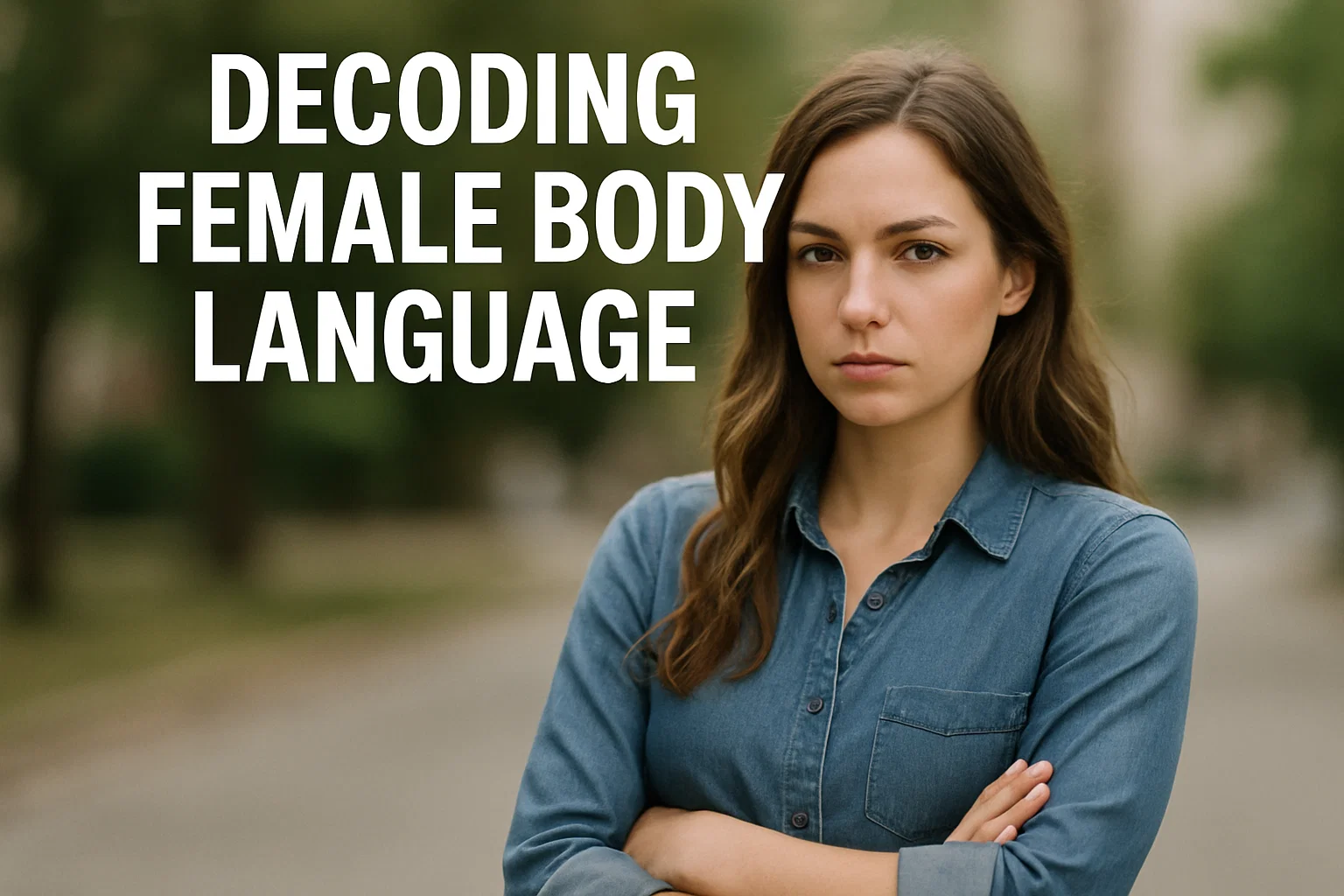
Context is everything. If she has her arms crossed, she might be closed off. Or… the restaurant might just be freezing cold. If she pulls away when you touch her, she might not like you. Or… she might just have a sunburn.
You have to look for clusters. Is she crossing her arms and looking away and pointing her feet at the door? That’s a “no.” Is she crossing her arms but leaning in and smiling with crinkly eyes? She’s just cold. Offer her your jacket. (Pro move, by the way).
Conclusion: It is about connection, not conquest
At the end of the day, learning to read these signs isn’t about “winning” the date. It’s about saving both of you time and heartache. It’s about respecting her unspoken boundaries and recognizing her unspoken desires.
When you can accurately read that I am nervous, and you crack a gentle joke to ease the tension, I feel seen. When you notice I am cold and leaning away, and you give me space, I feel respected.
Decoding female body language is ultimately an act of listening. It is listening with your eyes. So, on your next date, take a deep breath. Look at her. Really look at her. Forget the pickup lines. Feel the energy she is projecting. The answers are all right there, written in the silent language of the body. You just have to be brave enough to read them.
FAQs – Decoding Female Body Language
What are key body language signals to look for in a woman on a date?
Key signals include clusters of behavior such as her posture, eye contact, the way she claims or yields space at the table, and specific movements like hair or neck exposure, which indicate comfort or interest.
How can I tell if she is genuinely interested or just being polite?
A genuine interest is indicated by signs like a ‘sticky gaze,’ pupils dilation, the ‘eyebrow flash,’ mirroring behaviors, and open body language. Politeness often involves polite smiles and social masks that hide true feelings.
What does it mean if her feet point towards the door or away from me?
Feet pointing towards the door or away suggest that she is looking for an escape and may feel uncomfortable or uninterested. Feet pointing towards you, however, indicate engagement and interest.
How important is physical touch in decoding her feelings?
Physical touch can be a powerful indicator. Light, socially acceptable touches like a brush on the arm or hand can signal interest and openness, but it’s crucial to gauge her response and respect boundaries.
What is the significance of her smiling with her eyes versus just her mouth?
A genuine smile involves the entire face, including the eyes, which crinkle and create crow’s feet—indicating authentic joy. A polite or fake smile typically involves only the mouth, with the eyes remaining neutral.