

I was standing in my kitchen on a rainy Tuesday, staring at a sink full of dishes that had been soaking since Sunday. My husband was ten feet away in the living room, bathed in the blue light of his phone. The TV was on—some crime procedural we weren’t actually watching—and the only sound was the hum of the refrigerator. We weren’t fighting. We weren’t angry. We were just… existing.
We had slipped into what I now call the “efficient roommate” phase. You might know it. It’s where you high-five over paying the electric bill on time, but the last time you really looked at each other was to point out a piece of spinach in the other person’s teeth. The electricity between us hadn’t just dimmed; the power was out. I felt a panic rise in my throat, sudden and sharp. Was this it? Was this the rest of our lives?
I sat down at the sticky kitchen table and typed into the search bar: How to fix relationship drift. I didn’t want clinical advice. I wanted a life raft. That’s when I stumbled upon a concept that seemed almost too simple, too rhythmic to work. Forums were buzzing with the question: What is the Gottman 777 rule?
More in Category
How long do you date before becoming a boyfriend/girlfriend
Key Takeaways
- The 7-Day Pulse: You need to dedicate one evening every single week to a proper date. No phones. No work talk. Just you two.
- The 7-Week Reset: Plan an overnight getaway every seven weeks to strip away the household noise and remember who you are as a couple.
- The 7-Month Adventure: Take a longer vacation (even a staycation works) every seven months to build the big memories that act as glue.
- Science-Backed: The rule relies on the Gottman principle of “turning towards” your partner to build emotional capital.
- Consistency is Key: It’s not about the luxury of the date; it’s about the reliability of the connection.
Why does love feel so incredibly hard to sustain sometimes?
We start relationships with absolute fireworks. Do you remember those early days? I do. I remember staying up until 3 AM on a work night, sitting on the floor of his unfurnished apartment, talking about our childhood fears and whether aliens exist. You couldn’t keep your hands off each other. You were obsessed.
But then, life happens. And I don’t mean tragedy; I mean the slow, grinding erosion of routine. Careers demand our best energy during the day. Family obligations creep in on the weekends. The dog needs a vet appointment. The gutters are leaking. Suddenly, the Netflix queue becomes infinitely more enticing than a deep conversation because deep conversations require energy, and you are tapped out.
This drift is normal, but it is dangerous. The Gottmans call this “turning away” or simply ignoring the “bids for connection” your partner makes. When my husband would sigh about his day, I used to just say, “That sucks,” and keep chopping onions. I wasn’t trying to be cold. I was just distracted. I was thinking about the laundry. But those moments pile up. The 777 rule acts as a structural guardrail against this distraction. It forces us to stop the autopilot and grab the wheel before we drive off a cliff.
Is there actually a magic formula for connection?
It sounds skeptical, doesn’t it? When people ask, “What is the Gottman 777 rule?”, they are usually looking for a hack. We want a cheat code for intimacy. While the Gottmans themselves emphasize the “Magic 5 Hours” (five hours of dedicated connection per week), the internet crystallized this into the catchy 7-7-7 format. And honestly? It is brilliant in its simplicity.
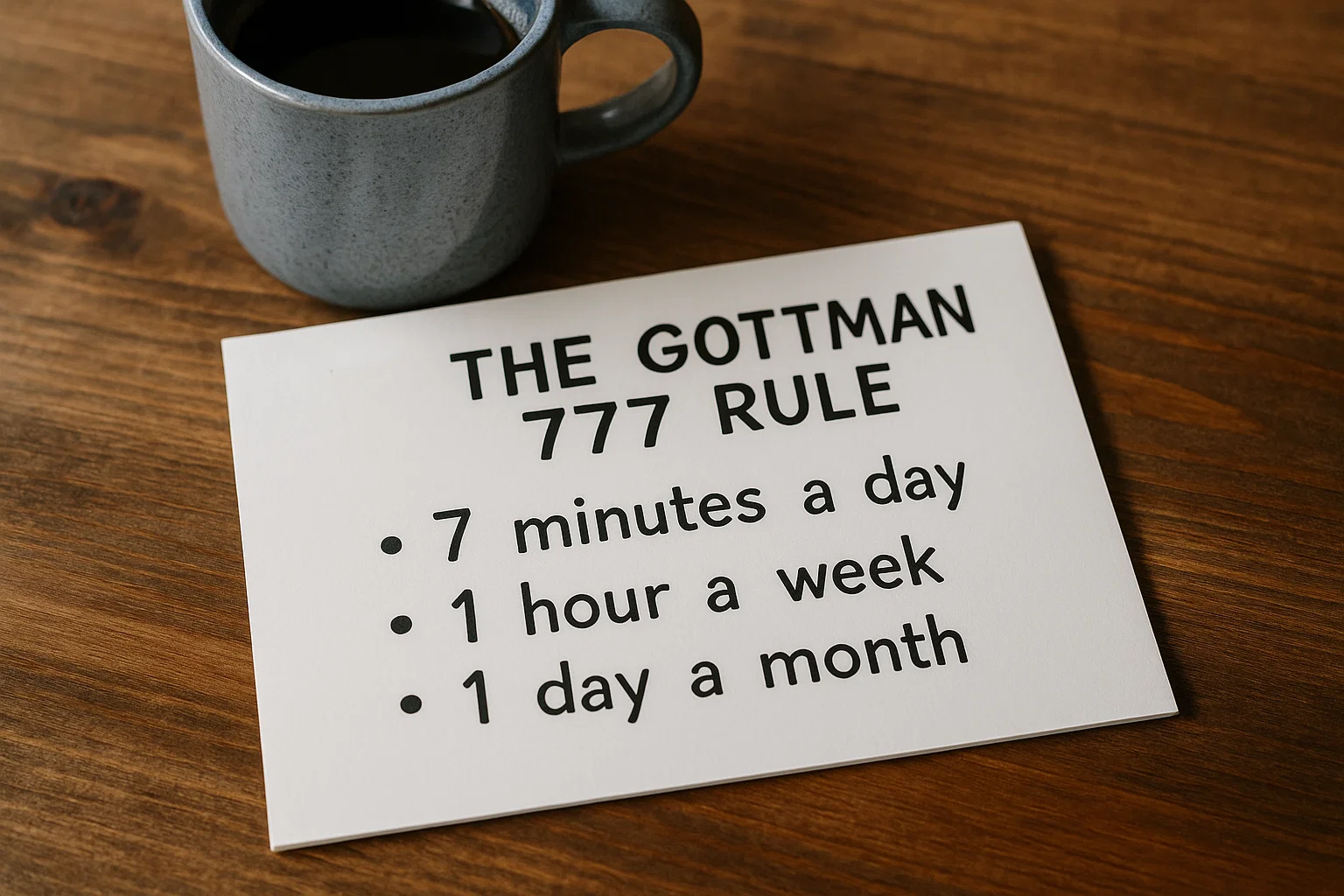
The rule breaks down like this:
- Every 7 Days: A date night.
- Every 7 Weeks: A night away.
- Every 7 Months: A romantic vacation.
It sounds like a lot of planning. I thought so too. I looked at my calendar and laughed. I barely had time to get my roots touched up, let alone plan three tiers of romantic engagement. But then I realized something sobering: I had scheduled dentist appointments, oil changes, and parent-teacher conferences for the next six months. I had scheduled the car’s maintenance. Why wasn’t I scheduling the maintenance for the most important relationship in my life?
Every 7 Days: Do we really need a weekly date night?
Yes. You absolutely do. And I am not saying “try to.” I am saying you must. This is the foundational layer of the rule. Every seven days, you and your partner need to carve out time just for the two of you.
I can hear your objections because they were my objections. “We’re too tired.” “Babysitters cost a fortune.” “We see each other every day, isn’t that enough?”
I said all those things. For months, our “date night” consisted of ordering Thai food and scrolling through our phones side-by-side on the couch while The Great British Baking Show played in the background. That is not a date. That is parallel play for exhausted adults.
The first time we tried to implement the proper 7-Day rule, it was a disaster. We went to a loud bar because we thought that’s what “dating” looked like. I had a headache. The drinks were overpriced. We ended up arguing about the monthly budget over a plate of cold nachos. I almost gave up right there. But the rule says every seven days, so the following week, we tried again. We lowered the stakes. We just took a walk in the park. No wallets. No phones. No distractions. We just walked and talked. And something clicked.
Gottman research highlights the importance of “Love Maps”—knowing your partner’s inner world. You cannot update your Love Map if you never talk about anything other than logistics and the kids’ schedules. The weekly date is your map-updating session. It says, “I choose you again this week.”
How do we keep weekly dates from becoming boring chores?
This is the trap. If you go to the same pizza place every Friday at 6 PM, eventually, that becomes a routine, and routines kill passion. Novelty releases dopamine in the brain. That’s the same chemical that flooded your system when you first fell in love. If every date night is predictable, you will autopilot that too.
We started a system: we take turns planning. One week, I plan the activity. The next week, he does. This shares the emotional labor—which, let’s be honest, usually falls on women—and adds an element of surprise.
Consider these low-effort, high-impact ideas:
- Cook a complex meal together. And I don’t mean tossing pasta in a pot. Pick something hard. Try making sushi or homemade ravioli. You will mess it up. You will laugh. That’s the point.
- Visit a local museum or gallery. Even if you just walk around and mock the weird art. It gives you something new to talk about.
- The “Question Jar.” We literally wrote random questions on scraps of paper and put them in a mason jar. We answer three of them over a glass of wine. Questions like “What’s one adventure you still want to take?” or “What was your favorite toy as a kid?”
You don’t need to spend money. You need to spend attention.
Every 7 Weeks: Why is an overnight escape necessary?
This is the part of the rule that usually makes people balk. An overnight trip every two months? In this economy? With these gas prices?
Here is the hard truth: your house is a stress box. I love my home, but it is full of triggers. The pile of mail on the counter reminds me of bills. The laundry basket reminds me of chores. The squeaky floorboard reminds me of repairs I haven’t booked. It is incredibly difficult to access your erotic, romantic, carefree selves when you are surrounded by your To-Do list.
The 7-Week overnight trip removes you from your domestic context.
I remember our first 7-Week attempt. We didn’t fly to Paris. We drove 40 minutes to a cheap Airbnb in the next town over. It was a converted garage. We dropped the dog at my mom’s house. The moment we closed the door to that rental, I felt my shoulders drop three inches. We weren’t “House Manager” and “Logistics Coordinator” anymore. We were just us. We ordered pizza and ate it in bed. We talked until 1 AM. It felt illicit. It felt like we were getting away with something.
Does it have to be a fancy hotel?
Absolutely not. The goal is a change of scenery, not luxury. If you are on a budget, go camping. Borrow a tent. There is something very bonding about struggling to set up a tent together (or watching him struggle while you read the instructions).
Swap houses with a friend for the night. You stay in their place; they stay in yours. It sounds weird, but it works! You get a new environment, and it costs you zero dollars.
Send the kids to their grandparents and have a staycation, but here is the catch: you have to pretend you aren’t home. No chores. No cleaning. Order takeout. Use paper plates. The Gottman research emphasizes that friendship and intimacy fuel the “Sound Relationship House.” This overnight break allows you to recharge that fuel tank. You need time to wake up slowly without an alarm clock screaming at you. You need time to be intimate without listening for little footsteps in the hallway.
Every 7 Months: Can a vacation really save us?
The final tier of the rule is the 7-Month vacation. This is the “Adventure” tier.
A vacation allows you to build a narrative together. When you are old and gray, sitting in your rocking chairs, you won’t remember the Tuesday you folded socks. You won’t remember the week you got the oil changed. You will remember the time you got lost in Rome. You will remember the time you got sunburned at the lake and laughed about it.
Shared experiences create a shared culture. Dr. Gottman talks about “creating shared meaning.” This is the attic of your relationship house, where you store your symbols, your rituals, and your memories.
My husband and I realized we hadn’t taken a trip longer than a weekend in four years. Four years! We saved up. We went to the mountains for five days. We hiked until our legs burned. We ate terrible trail mix. We talked about our five-year goals—where we wanted to be, what we wanted to build. By the time we came home, we felt like a team again. We had faced “adversity” (okay, it was just a steep hill and a rainstorm, but still) and survived.
What does the science actually say about this rhythm?
While the “777” structure is a catchy internet framework, the principles are deeply rooted in the Gottman Institute’s findings. Their research, spanning decades of studying couples in the “Love Lab,” points to one undeniable fact: successful couples turn toward each other in small ways, often.
The “Magic Ratio” dictates that for every negative interaction during conflict, a stable marriage has five positive interactions. The 777 rule generates a massive amount of positive interactions.
- The Weekly Date creates a consistent buffer of positive sentiment. It reminds you why you like this person.
- The Overnight fosters physical and emotional intimacy, releasing oxytocin—the bonding hormone.
- The Vacation builds an overarching sense of “us against the world.”
By adhering to this schedule, you are essentially banking emotional currency. When the inevitable fights happen (and they will happen), your bank account is full enough to absorb the withdrawal without going bankrupt.
What happens if we break the chain?
Life is messy. Kids get the stomach flu. Work projects explode. Bank accounts run dry. If you miss a date night or push the vacation back a month, does the whole system crumble?
No. Rigidity is the enemy of romance. The purpose of the rule is to prioritize connection, not to create another source of stress. If you treat this like a drill sergeant’s order, you will resent it.
I missed three weekly dates in a row last November. I was swamped at work, pulling 12-hour days, and I just wanted to sleep. I told my husband, “I can’t do the date night. I need a coma night.” He understood. But—and this is crucial—we rescheduled. We didn’t let the “cancel” become the new normal. We acknowledged the slip and got back on the wagon the next week.
How can you adapt this to your budget?
I hate reading advice that assumes we all have unlimited disposable income. Financial stress is a leading cause of divorce, so we don’t want our solution to cause the problem.
Here is how I hacked the 777 rule for a tight budget:
- 7 Days: A walk, a bike ride, or a “picnic” on the living room floor with wine and cheese after the kids are asleep. Cost: $15 max.
- 7 Weeks: Camping is your best friend. Or, ask friends to swap homes. Or find a cheap motel in a weird town and explore it like tourists. Cost: Gas money and a cheap room.
- 7 Months: Look for off-season deals. Go to the beach in October. Go to the mountains in the spring. Or do a “house swap” vacation. We once drove to a state park and stayed in a rustic cabin that cost $60 a night. It wasn’t the Ritz. The shower was lukewarm. But the fire was warm, and the company was good.
Does strict scheduling kill the romance?
“Spontaneity is a myth,” I tell my friends, and they look at me like I’m crazy. But think about it. We schedule our dentist. We schedule our meetings. We schedule our hair appointments. Why do we think romance should just magically happen in the cracks of our busy lives?
Waiting for “the mood to strike” is a recipe for a sexless, distant marriage. Desire, especially in long-term relationships, is often responsive, not spontaneous. You have to create the container for it to flow into.
When I see “Date Night” on the calendar, I start looking forward to it on Wednesday. The anticipation itself is an aphrodisiac. I might put on a little extra mascara that morning. I might send a flirty text. The structure creates the freedom to be romantic. It tells your brain: “Friday night is for us.”
What if my partner isn’t on board?
This is the hurdle. You read this article and think, “Yes! Let’s do it!” He reads it (or you read it to him) and he thinks, “Great, more obligations. More work.”
Start small. Don’t present it as a rigid contract or a demand. Frame it as an experiment. Say, “Hey, I miss you. I feel like we haven’t really talked in a while. Can we try doing a dedicated date night for just one month and see how it feels?”
Positive reinforcement works on grown men just as well as it works on children. When you do go on that date, make sure he has a good time. Don’t use the date to complain about his mother or the budget or the fact that he didn’t unload the dishwasher. Make it fun. If he associates the “777” activities with pleasure and connection, he will eventually be the one booking the Airbnb for the 7-Week trip.
How do we handle the “Four Horsemen” during these times?
The Gottmans identified four communication styles that predict divorce with frightening accuracy: Criticism, Contempt, Defensiveness, and Stonewalling.
The 777 rule is your best defense against them.
- Criticism usually stems from unmet needs. Regular check-ins reduce those unmet needs.
- Contempt is born of long-simmering resentment. Regular fun and fondness kill resentment before it grows.
- Defensiveness happens when we feel attacked. During a relaxing getaway, our guards come down.
- Stonewalling is shutting down. You can’t stonewall when you are hiking a trail together or sharing a tent.
Use your 7-Day dates to practice “soft start-ups.” Instead of saying, “You never help clean,” try, “I feel overwhelmed when the kitchen is messy, and I would love your help.”
Are you ready to rewrite your love story?
It is a search for hope. It is an admission that what you are doing right now isn’t working, and you want something better.
I implemented this rule two years ago. Are we perfect? No. Do we still bicker about the dishwasher? Yes. Do we sometimes stare at our phones instead of each other? Of course. But the silence in the house is gone. The “roommate” vibe has evaporated. We are partners again. We are lovers again.
Relationships are not static statues that you build once and admire forever. They are living, breathing things that require nutrition. The 777 rule is just a diet plan for your love life. It feeds the relationship the time, attention, and novelty it needs to thrive.
So, open your calendar right now. Mark the dates. It might feel unromantic to treat your marriage like a business meeting, but I promise you, the results are pure magic. Start with this Friday. Just you, him, and two hours of uninterrupted time. You might be surprised by how much you still have to say to each other.
Learn more about the research behind these principles at The Gottman Institute
FAQ – What is the Gottman 777 rule
Why is a weekly date night considered essential according to the 777 rule?
A weekly date night is essential because it provides a consistent opportunity for partners to reconnect, update their Love Maps, and keep the romance alive amidst routine and everyday stresses. It helps prevent emotional drift and maintains a sense of closeness.
How can couples implement the 777 rule on a tight budget?
Couples can adapt the 777 rule by planning low-cost activities such as walks, picnics, or home-cooked meals for weekly dates; camping, house swaps, or staycations for their biweekly overnight trips; and off-season local trips or rustic cabins for their longer vacations, focusing on quality time rather than expense.
What if one partner is hesitant or not on board with the 777 schedule?
Start by introducing the idea as a temporary experiment rather than a rigid rule. Emphasize the desire for connection and fun, and focus on making activities enjoyable. Positive reinforcement and small, manageable steps can encourage reluctant partners to engage and eventually embrace the structure.